
Introduction
An industrial radio remote control system relies on two critical hardware components working in total synchronization: the industrial wireless transmitter, operated on the shop floor, and the industrial wireless receiver, installed inside the machine control cabinet. Together, they form an essential wireless link that translates human inputs into instantaneous machine movements.
Selecting the right combination of transmitter and receiver is vital to achieving optimal control response, maintaining operator safety, and ensuring seamless electrical integration. This guide breaks down key technical considerations for selecting, pairing, and installing industrial RF control hardware.
Part 1: Selecting the Right Industrial Wireless Transmitter
The transmitter serves as the operator’s primary interface. Its design directly impacts operational efficiency, switch durability, and ergonomic comfort over multi-hour shifts.
- Push-Button Radio Remote Control Transmitters: Ideal for standard lifting equipment, monorail hoists, and straightforward material handling setup. Operators benefit from distinct tactile feedback, robust emergency stop switches, and durable keypads.• RAS Product Range: The RAS Dove Series and RAS Swan Series offer compact, highly durable push-button designs featuring low power consumption and robust RF signal stability.
- Heavy Duty Industrial Joystick Remote Control : When machines require simultaneous multi-axis control, stepless speed adjustments, or delicate positioning, push buttons are insufficient. An industrial joystick remote control allows operators to guide complex boom movements, slewing functions, and heavy winches effortlessly.
RAS Product Range
The RAS Hawk Series provides heavy-duty, dual-axis joystick remotes built for harsh construction, mining, and heavy foundry environments.
- Enclosure Rating: Minimum IP65/IP67 dust and water resistance for outdoor and high-dust environments.
- Battery Management: Long battery run-times using rechargeable lithium-ion or standard AA batteries, combined with low-voltage warning LEDs.
- Ergonomics & Weight: Balanced weight distribution and waist/shoulder strap attachment points to reduce physical strain.
Part 2: Selecting and Integrating the Industrial Wireless Receiver
While the transmitter captures operator intent, the industrial wireless receiver executes it. Mounted inside or adjacent to the machine’s main control panel, the receiver converts incoming radio signals into digital or analog relay outputs that drive contactors, VFDs, or hydraulic valves.
Key Criteria for Choosing a Receiver:
- Relay Capacity and Scalability: The receiver must provide enough output relays to match all required machine motions (e.g., hoist up/down, trolley east/west, bridge north/south, horn, and main line contactor).
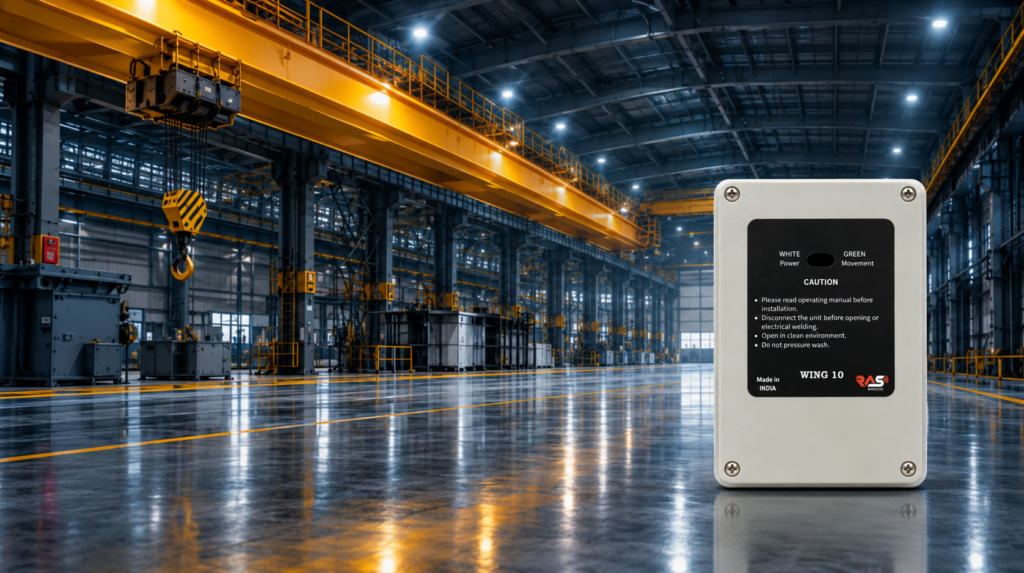
- RAS Wing Series: Offer modular output capacity spanning the compact Wing 10, versatile Wing 19, and expanded Wing 40 receivers to handle simple hoist setups as well as multi-function industrial cranes.
2 . 2RF Signal Immunity: Industrial plants are filled with electrical noise generated by high-power motors, VFDs, and welding equipment. Modern radio remote control receiver units utilize narrow-band RF modules and digital signal filtering to eliminate interference and prevent dropped signals.
- Antenna Placement : Mount the receiver’s external antenna outside metal enclosures, clear of structural steel beams, high-voltage conduits, or variable frequency drives.
- Vibration Isolation : Use rubber shock mounts when attaching receiver enclosures to high-vibration machinery like crushing plants or stamping presses.
- Regular Inspection Routine : Regularly inspect push-button rubber boots, emergency stop switches, transmitter battery contacts, and panel wiring terminals during scheduled maintenance.