Introduction
In modern manufacturing facilities, heavy engineering yards, steel mills, and warehouses, material handling forms the backbone of daily operations. Moving multi-ton loads using overhead travelling cranes, gantry systems, and heavy hoists demands absolute precision, seamless control, and zero margin for error. Historically, operators relied on traditional wired pendant controls or elevated cabin controls to maneuver these massive machines. However, as factories evolve toward higher safety standards and leaner operational workflows, the shift toward a modern Industrial Radio Remote Control System has become an industry standard rather than an option.
Replacing restrictive cables with advanced wireless technology fundamentally transforms how material handling equipment is operated. A reliable industrial wireless remote control bridges the gap between operator mobility and machine precision, ensuring safer work environments, reduced equipment downtime, and optimized productivity.
The Operational Limitations of Wired Pendant & Cabin Controls.
- Restricted Operator Position: Pendant controllers tether the operator directly beneath or adjacent to the moving load. This creates serious safety hazards, particularly when handling molten metal, heavy castings, or sharp steel plates.
- Limited Line of Sight: In cabin-operated cranes, operators often face severe blind spots, relying heavily on ground spotters through hand signals. This introduces communication delays and increases the risk of collisions.
- Cable Wear and Maintenance Downtime: Trailing pendant cables suffer constant mechanical stress, twisting, and snagging against shop-floor obstacles, leading to frequent wiring faults and unexpected production halts.
Key Advantages of Upgrading to an Industrial Wireless Remote Control
- Transitioning to a high-performance industrial remote control system directly addresses these operational bottlenecks.
- Enhanced Operator Safety and Ergonomics
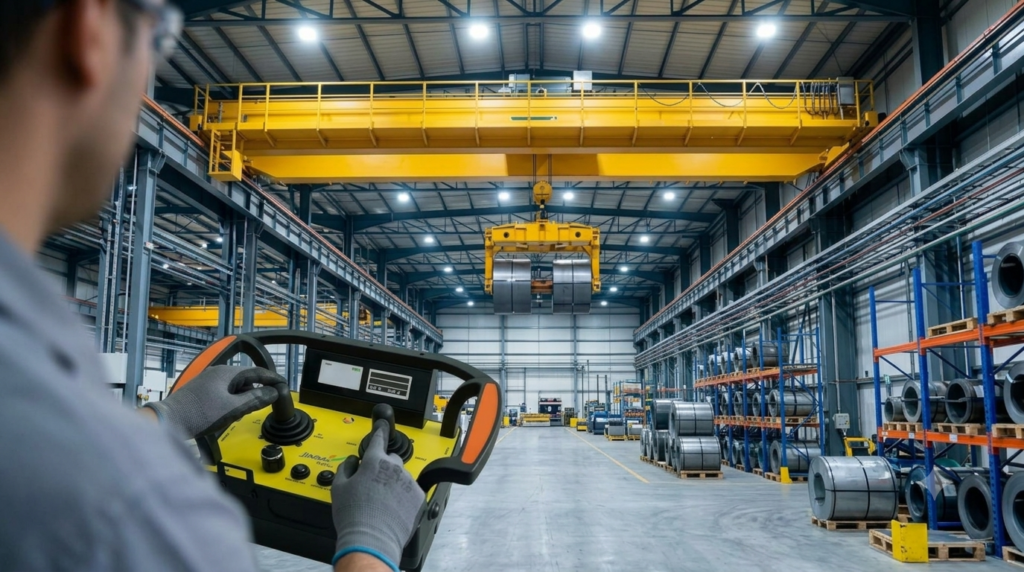
With a wireless crane remote, the operator can select the safest vantage point on the shop floor. By maintaining a safe distance from suspended loads, hazardous chemicals, or high-heat zones, operators significantly reduce the risk of injury. Furthermore, lightweight, ergonomically designed transmitters prevent operator fatigue during long shifts. - Superior Precision and Productivity
Equipped with multi-speed push buttons or proportional joysticks, a crane remote controller offers millimeter-level control. Operators can smoothly position heavy components into CNC machines, assembly jigs, or storage racks without relying on secondary spotters. This single-operator capability drastically improves load transfer cycle times. - Reduced Maintenance and Cable Elimination
By eliminating physical control cables and festoon wires dedicated to pendants, plant engineers drastically lower hardware wear and tear. This translates to fewer emergency maintenance calls and prolonged machine availability.
Tailored Control Solutions for Crane Applications
Different lifting operations require specialized control configurations. Deploying the right hardware ensures maximum efficiency across specific machinery types.
- EOT Crane Remote Control
Electric Overhead Travelling (EOT) cranes operate across expansive factory bays. An EOT crane remote control requires long-range RF stability, high noise immunity, and fast response times to command bridge, trolley, and hoist motors simultaneously. - Hoist Crane Wireless Remote Control
For monorail hoists and localized workstation cranes, a compact hoist crane wireless remote control gives operators full freedom to guide loads gently into place. Smooth inching capabilities prevent load swinging and equipment shock loads. - Heavy-Duty Material Handling Remote Control
In outdoor material handling yards, mining sites, and construction zones, a material handling remote control must withstand extreme weather conditions, high vibration, and dust ingress while maintaining continuous RF connectivity.
Safety Standards & Technical Requirements
When selecting an industrial wireless transmitter and receiver pair for crane applications, safety compliance is paramount. Modern systems incorporate essential safety features:
- Fail-Safe Emergency Stop (E-Stop): Category 3 / Category 4 functional safety relays that immediately cut power to crane drives upon pressing the red E-stop button.
- Frequency Hopping & Channel Management: Automatic channel switching prevents interference from neighboring wireless equipment, Wi-Fi networks, or radios.
- Unique ID Coding: Every paired transmitter and receiver communicates using a unique digital address code, ensuring zero signal crosstalk between adjacent cranes in the same bay